
Fear of failure can look like procrastination, overthinking, perfectionism, or quitting early—often not because of a lack of ability, but because the mind is trying to avoid discomfort. Confidence grows when action becomes safer than avoidance. This guide breaks fear of failure into workable pieces and offers simple tools to practice courage, learn faster, and keep momentum—without forcing a fake “positive mindset.”
Fear of failure is often a protective response. The brain can treat uncertainty, social judgment, and identity threats as “danger,” even when the stakes are mostly emotional. That’s why the urge to avoid can feel urgent and logical—even when you want the goal.
One helpful way to understand confidence is “self-efficacy”—the sense that you can handle challenges through effort and strategies, not that you’ll always get perfect outcomes. The American Psychological Association defines the term here: APA Dictionary: Self-efficacy.
Fear of failure tends to run on a loop: a trigger shows up, your mind predicts an outcome, you protect yourself, you get short-term relief, and then the habit gets stronger. Naming the loop makes it easier to interrupt.
| Pattern | What it sounds like | What to do next (5–15 minutes) |
|---|---|---|
| Perfectionism | “If it’s not great, it’s pointless.” | Set a “version 1” goal and ship the smallest usable draft. |
| Procrastination | “I’ll start when I feel ready.” | Start a 10-minute timer; do only the first step. |
| Over-researching | “I need one more course/book.” | Write 3 questions, then test one in real life today. |
| Comparison | “Everyone is ahead of me.” | Track only personal progress: one measurable metric for 7 days. |
| All-or-nothing thinking | “If I can’t do it perfectly, I’ll stop.” | Define a “minimum win” that counts even on low-energy days. |
Mindset shifts aren’t about pretending you aren’t afraid. They’re about changing what you measure and what you make “meaningful” so action feels doable even with nerves present.
If fear regularly escalates into intense worry or panic, it may help to learn more about anxiety patterns and support options: National Institute of Mental Health: Anxiety Disorders.
Confidence grows fastest when you run small experiments that generate feedback—then review them without shame. Think “lab notes,” not “report card.”
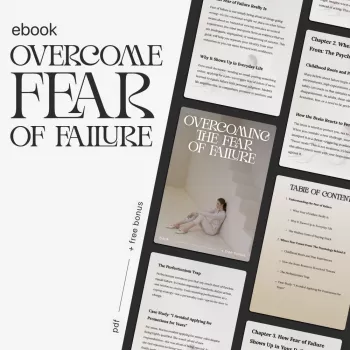
For structured prompts and repeatable exercises, Overcoming the Fear of Failure | Digital eBook for Mindset Growth | Learn How to Overcome Fear of Failure and Build Confidence is a guided option designed for consistent practice when motivation is shaky.
One reason fear can feel so persuasive is that protective thinking can distort what seems “true” in the moment. For a deeper perspective on self-protective reasoning, see: Stanford Encyclopedia of Philosophy: Self-Deception.
If confidence-building is part of a bigger “show up anyway” routine, supportive basics can help you follow through. Comfortable movement can lower friction for action days: Breathable Padded Halter Sports Bra. And choosing an easy, put-together outfit can reduce overthinking before leaving the house: Women’s Wide-Leg Pants.
Procrastination often works as short-term anxiety relief: avoiding the task drops discomfort quickly, so the brain learns to repeat it. A fast reset is to set a 10-minute timer and do only the first step—small starts weaken the avoidance loop.
Early inconsistency is normal when you’re learning a skill; confidence comes from reps and feedback, not perfect streaks. Track completion (attempts finished) and set a “minimum win” standard so progress counts even on uneven weeks.
Name the fear in one sentence, write the smallest next step you can start in under 5 minutes, then set a timer for 10 minutes and begin. As a reality-check, ask: “What evidence contradicts my worst-case prediction?”











Leave a comment