
When anxiety is loud, “just think positive” can feel like pressure, not help. A calmer middle path is possible: realistic hope, grounded self-talk, and a repeatable pattern-shift sequence for moments of overthinking and worst-case spirals—without denying what feels hard.
Forced positivity often asks the mind to skip over uncertainty and jump straight to a “good outcome.” When the body still feels unsafe, that jump can create internal conflict: part of you is trying to soothe, while another part is scanning for danger. The result is often more tension, not less.
Anxiety tends to respond better to credibility than cheerleading. If self-talk sounds untrue (“Everything is fine!”), the anxious brain may argue back with doubt, checking, and mental replay. That can lead to more rumination, more reassurance seeking, and a stronger belief that you must eliminate uncertainty before you can move forward.
A more sustainable alternative is compassionate realism: validating discomfort while widening the range of possible outcomes beyond catastrophe. Instead of “I must feel better now,” shift toward “I can handle this moment.” That subtle change reduces urgency and creates room for clearer thinking.
“Expect better” isn’t a guarantee. It’s a stance that the next step can be safer, clearer, or more workable than the anxious prediction. It separates feelings from facts: feelings are real signals, but they aren’t proof that the worst outcome is inevitable.
This approach aims for flexible thinking: multiple possible outcomes, multiple options, and a plan for coping either way. Instead of all-or-nothing predictions (“It will be terrible”), it uses probability-aware thinking (“Several outcomes are possible; I can prepare for the most likely”). For a quick overview of how anxiety works and why uncertainty feels so intense, see the American Psychological Association’s overview of anxiety or the National Institute of Mental Health guide to anxiety disorders.
When you’re caught in a loop, insight alone may not stop it. A repeatable sequence helps because it gives your mind something concrete to do.
Name what’s happening: overthinking loop, catastrophic story, reassurance seeking, mental replay. Naming creates a small pause—often just enough to stop the spiral from accelerating.
Before you debate your thoughts, lower arousal. Try a slow exhale (longer out-breath than in-breath), unclench your jaw and shoulders, and feel your feet on the floor. A calmer body makes your thinking more accurate.
Specific beats vague. Example: “I’m afraid I’ll make a mistake in the meeting and be judged.” One sentence reduces the fog of dread and gives you something workable to respond to.
Trade absolute predictions for realistic statements your nervous system can accept. The goal isn’t to “win” against anxiety—it’s to become less trapped by it.
Pick one practical step that moves from rumination to agency: draft a note, set a timer, ask one clarifying question, or do a two-minute prep task. Tiny actions build evidence that you can cope.
| Anxious thought | More believable reframe | Next tiny action |
|---|---|---|
| “This is going to be a disaster.” | “This might be uncomfortable, but I’ve handled discomfort before.” | List 2 likely outcomes and 1 coping step for each. |
| “If I can’t stop thinking, something is wrong with me.” | “My mind is trying to protect me; I can redirect it gently.” | Set a 5-minute worry timer, then switch tasks. |
| “If I feel anxious, it means I’m not ready.” | “Anxiety can show up even when I’m prepared.” | Do one prep action (review notes, pack bag, send confirmation). |
| “I need certainty before I act.” | “I can act with partial information and adjust.” | Pick the smallest reversible step and do it now. |
When anxiety spikes, start with language that validates your experience and then guides you back to reality and capability.
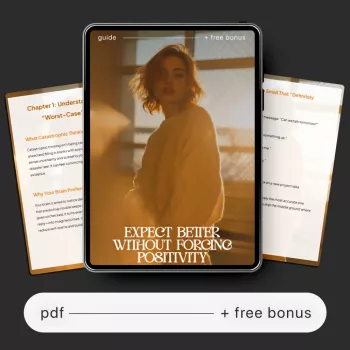
If you want the method in a quick-reference format, Expect Better Without Forcing Positivity – Anxiety Reframe Guide (digital download) is designed for real-life spirals: clear steps to follow when thinking gets sticky, self-talk prompts that practice compassionate realism, and a pattern-shift structure that pairs cognitive reframes with small actions to reduce rumination and increase agency.
A supportive routine can be as small as: reframe → one stretch → one practical step (email draft, calendar check, water break). If movement helps, comfort-focused clothing can make breathing and posture easier during a reset—like a supportive, non-restrictive option such as the Breathable Padded Halter Sports Bra. For a calmer “get through the day” feel, some people also like easy, relaxed-fit basics like Women’s Wide-Leg Pants that don’t add extra sensory stress.
No. Toxic positivity dismisses hard feelings; this approach validates them, acknowledges uncertainty, and focuses on believable reframes plus coping capacity rather than pretending everything is fine.
Yes, especially if you keep it simple: do brief grounding, write the fear in one sentence, choose a believable reframe, schedule a “review time” tomorrow, and return attention to your breath and body.
No. It’s a self-help tool for practicing skills; professional support can be important for persistent distress, impairment, panic, trauma symptoms, or safety concerns.











Leave a comment