Small Talk Made Simple: A Printable Guide to Better Conversations and Everyday Social Skills
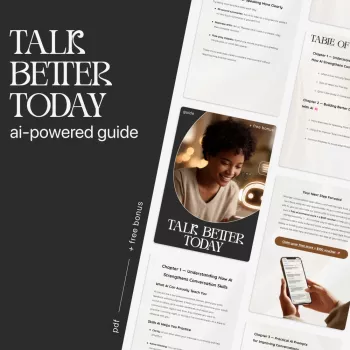
Small talk gets easier when there’s a simple structure to follow. Small Talk Made Simple printable digital guide is designed to turn awkward pauses into comfortable connection with practical prompts, low-pressure conversation starters, and quick ways to keep a chat going—at work, in class, at events, or even during everyday errands.
Instead of trying to “be interesting,” this approach focuses on being present, curious, and easy to talk to. Small shifts—like asking a question that can’t be answered with a single word or using a simple bridge phrase—can make conversations feel smoother fast. If you want a supportive refresher, Harvard Business Review offers helpful perspectives on conversational habits and how to improve them over time (Harvard Business Review), and the American Psychological Association highlights how much nonverbal communication shapes comfort and trust (APA: Nonverbal communication and body language).
Who this guide helps (and when it’s most useful)
- People who freeze up when meeting someone new and want a simple “what to say next” framework
- Anyone returning to social situations after a quiet season and wanting a gentle restart
- Professionals who want smoother networking without sounding scripted
- Students, remote workers, and new team members building rapport quickly
- Situations: parties, waiting rooms, elevators, school pickup lines, meetings, dates, and community events
The goal isn’t to carry every interaction—it’s to create a few reliable “handles” you can grab when the moment feels uncertain. When you have a plan for starting, continuing, and ending a conversation, the pressure drops and connection gets easier.
What’s inside “Small Talk Made Simple”
- Conversation starters that work across common settings (work, casual events, errands)
- Follow-up question prompts that reduce one-word answers
- Easy ways to shift from surface chat to meaningful connection (without oversharing)
- Phrases for joining group conversations and re-entering after a pause
- Printable format for highlighting favorites, adding notes, and keeping quick-reference pages handy
- Digital download: instant access and re-printable for personal use
Quick view: skills covered and what they unlock
| Skill |
What to try |
What it helps with |
| Starting |
Neutral openers + context-based comments |
Breaking the initial awkwardness |
| Continuing |
Follow-ups that invite stories |
Avoiding dead ends and short replies |
| Listening |
Reflecting + curiosity prompts |
Making people feel heard |
| Transitioning |
Bridge phrases to new topics |
Moving beyond weather talk naturally |
| Exiting |
Warm wrap-ups + next-step lines |
Leaving without feeling abrupt |
A simple conversation flow to practice anywhere
Think of small talk like a relaxed six-step loop. You don’t need to use every step perfectly—just having the sequence in mind helps you recover when your mind goes blank.
- Notice shared context: mention something neutral about the place, event, timing, or what’s happening (“This line moves faster than I expected.”).
- Ask a low-stakes question: choose something with multiple possible answers, not yes/no (“Have you been here before, or is this your first time?”).
- Invite a story: use a follow-up like “How did that start?” or “What was that like?” to open the door for details.
- Share one small detail: offer a single sentence about your side to build reciprocity (“I’m new to this area, so I’m collecting recommendations.”).
- Transition with a bridge: “Speaking of…” or “That reminds me…” helps you move topics without forcing it.
- End well: wrap up warmly and optionally take a next step (exchange names, connect later, or simply wish them well).
Everyday conversation starters that don’t feel forced
Natural small talk often starts with the simplest ingredient: what’s already happening. These openers work because they fit the moment, not because they’re clever.
- Errands and public spaces: “Have you tried this brand?” “Is there a better time to come here when it’s less busy?” “Any local coffee place you’d recommend?”
- Work and networking: “What are you focused on this week?” “How does your team fit into the project?” “What’s been keeping you busy lately?”
- Events and gatherings: “How do you know the host?” then branch to “How long have you been in the area?” or “What do you like to do outside of work?”
- Friendly re-starts after a pause: “You were saying…” “Where were we?” or “So the last thing you mentioned was…”
- When unsure what to say: choose curiosity over performance—ask about their experience, not their résumé.
How to handle common small-talk hurdles
Making it feel natural: tone, timing, and boundaries
Ways to use the printable eBook in real life
If confidence also shows up in how you feel physically comfortable in the room, having a go-to outfit can remove one more mental distraction—options like the Women’s Wide-Leg Pants or the Breathable Padded Halter Sports Bra can support an easy, relaxed “show up and breathe” mindset on busy days.
Product details at a glance
FAQ
Is this guide helpful for people who feel anxious about small talk?
Yes. It’s built for low-pressure practice with repeatable patterns, so you can focus on small, doable goals (like a two-minute chat) instead of trying to be perfect.
What do you get with the digital download?
You’ll receive a printable eBook file for personal use with instant access. You can reprint pages anytime and keep quick-reference sections handy for before meetings, events, or everyday errands.
How can this help in work or networking settings without sounding rehearsed?
It uses flexible frameworks—context-based openers and follow-ups that invite stories—so your words can match the moment. Instead of memorizing a script, you learn a natural flow you can adapt to different people and settings.
Recommended for you













Leave a comment