
Spotting what’s changing is easy; deciding what to do with it is harder. An effective forecast turns scattered clues—search spikes, community chatter, competitor launches, policy shifts—into a repeatable decision workflow. The goal isn’t to “call the future.” It’s to make smarter bets with documented assumptions, clear scenarios, and a watchlist that keeps you honest as the market moves.
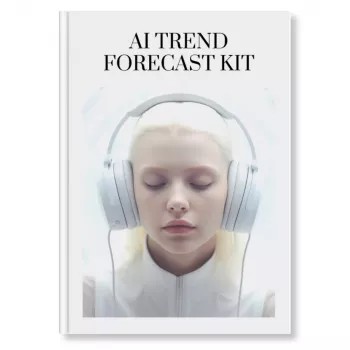
If you want a lightweight system you can run week after week, the AI Trend Forecast Kit is built for exactly that: turning early signals into evidence-backed actions for product ideas, campaigns, and roadmaps.
A trend forecast is a structured view of emerging shifts that could affect customers, competitors, and distribution channels. Instead of collecting “cool stuff,” you’re mapping signals to drivers, and drivers to business implications—then deciding what to test next.
It’s also important to define what a forecast is not. It’s not a guarantee, and it’s not a single bold prediction. Strong forecasts outline a small set of plausible scenarios, each tied to measurable indicators you can track. That’s how you avoid overcommitting to a narrative that felt exciting in week one but fizzles by week six.
A lightweight process usually beats a one-time “big report.” Markets shift continuously, and the ability to refresh inputs, update confidence levels, and adjust actions is more valuable than a glossy PDF that goes stale.
This kind of workflow is especially useful when decisions are frequent and attention is limited. AI-assisted synthesis can speed up clustering, summarizing, and scenario drafting—while your judgment stays focused on what matters: relevance, feasibility, and timing.
For context on why hype and adoption often diverge, frameworks like the Gartner Hype Cycle can be a useful reference point for thinking in phases rather than headlines.
The kit is designed to standardize research, scoring, and decision steps so forecasts are comparable across projects and easy to update. It includes a checklist (to ensure you don’t skip critical steps), a guide (to keep terms and method consistent), and a ready-to-use pack of prompts (to accelerate synthesis and scenario building without hand-waving).
| Component | Used for | Best moment to use it |
|---|---|---|
| Checklist | Ensuring each forecast covers signals, drivers, counter-signals, and risks | At the start of each new trend topic |
| Guide / eBook | Explaining the method and keeping terminology consistent | When setting up the process or onboarding collaborators |
| Prompt pack | Summarizing sources, generating scenarios, mapping implications, drafting positioning ideas | After collecting raw notes and links |
If you like having decision tools organized in one place, you may also appreciate structured downloads like the Are You Ready? Pet Adoption Decision Workbook—a separate product, but built with the same “reduce uncertainty with a process” mindset.
A forecast becomes useful when it connects directly to a decision and ends with a next action. Here’s a weekly loop that stays lean without becoming shallow:
When you’re collecting signals, it helps to balance fast sources (platform updates, creator communities) with slower, high-quality baselines (industry and demographic research). Resources like the Pew Research Center can provide grounded context that keeps you from overreacting to one noisy week.
| Criterion | What to look for | Simple score (1–5) |
|---|---|---|
| Customer pull | Clear “I need this” language, repeat requests, willingness to pay | 1 (weak) to 5 (strong) |
| Market momentum | More launches, more budget allocation, more coverage across sectors | 1 to 5 |
| Feasibility | Accessible tools, supply chain readiness, compliance clarity | 1 to 5 |
| Time horizon | How soon it could impact revenue or positioning | 1 (long) to 5 (near-term) |
| Strategic fit | Matches brand strengths, channels, and capabilities | 1 to 5 |
Forecasting isn’t limited to digital products, either. Consumer categories move fast—silhouettes, fabrics, and styling cues can shift within a season—so even retail decisions benefit from a clear signal-to-action loop. If you’re tracking apparel micro-trends and testing demand, products like Women’s Wide-Leg Pants can be a concrete way to connect a style signal to merchandising and messaging experiments.
For teams that want a ready-made structure, the AI Trend Forecast Kit keeps the process consistent so insights don’t disappear into scattered tabs and half-finished notes.
Yes. Use it to check whether a trend reflects real customer pull, clarify the target segment, and pick a small test that can confirm demand quickly before you invest heavily.
It’s tool-agnostic: pair any AI assistant for synthesis with the sources you already use, such as analytics, marketplaces, social platforms, newsletters, and industry reports.
Fast-moving categories often benefit from weekly or biweekly updates, while slower industries may only need monthly refreshes. The key is keeping a consistent watchlist with clear confirm/invalidate signals.












Leave a comment